|
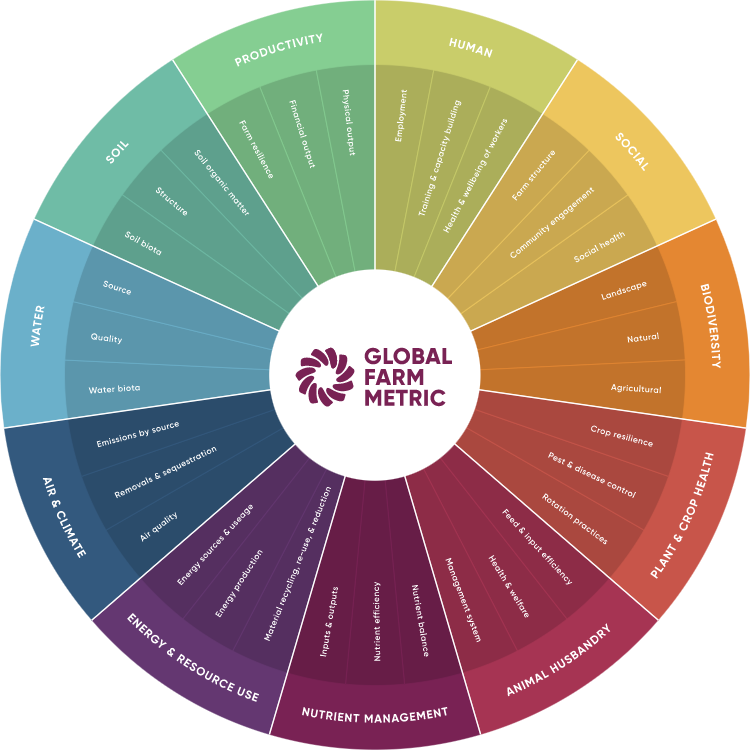
Global Farm MetricFarm Sustainability Assessment ToolOAK has created FARM Tool, a farm resilience assessment tool (also referred to as a farm sustainability assessment tool) in collaboration with Kentucky farmers. This tool is a US-based adaptation of the Global Farm Metric (GFM) framework, stewarded by the Sustainable Food Trust. The GFM framework measures social, economic and environmental indicators across 12 categories to assess the state of on-farm sustainability.
Explore the 2022-2025 Report
Based on globally recognized research, OAK staff have built this tool around the GFM framework by embedding it with relevant measures and a benchmark scoring system that allows farmers to understand their individual farm data in the context of peer farms as well as established Kentucky, US, and global datasets. The tool also points farmers to best practices from the USDA Natural Resources Conservation Service (NRCS), and taps into Cornell University's Environmental Impact Quotient system for measuring the impact of farm pesticides. In addition, the tool connects farmers to a broader set of resources, including a suite of animal welfare standards, NOAA's Climate Time Series, the National Integrated Drought Information System, soil health and fertility benchmarks that place a farmer's own soil sampling results in context, the National Wildlife Federation's Keystone Native Plants for the Eastern Temperate Forest Ecoregion, and Agricultural Justice Project standards. The FARM Tool establishes a common language, supported by quantitative measures, that enables all stakeholders in food and farming to drive positive change.
OAK's GFM-FSAT Development and Farm Trials Timeline Since OAK began adapting this tool for US-based farms, several cohorts of producers have participated in trials and have completed the tool for their operations.
In the spring of 2023, six OAK member farmers were part of the initial trial. Farmer feedback and insights from this trial were integrated into tool adaptations, and another 25 specialty crop farms participated in a research trial in Fall 2023 that investigated the updated the tool and included on-farm technical assistance that provided quantitative measurements of soil fertility and health, water quality and crop quality. This research was supported by a Specialty Crop Block Grant through the Kentucky Department of Agriculture and the Owsley Brown II Family Foundation. The FARM Tool is now the cornerstone of OAK's Soil Health Project, relaunched in 2026 as part of the USDA's Advancing Markets for Producers initiative. This marks the next chapter for OAK's work in helping Kentucky farmers understand, measure, and strengthen the resilience of their operations. Through it, 71 farms across the state completed the FARM Tool as their entry point into a broader effort that pairs whole-farm assessment with direct technical assistance, individualized resilience planning, market development and financial incentives for farmers building healthier, more productive land and businesses.
For an international look at the Global Farm Metric, you can explore Sustainable Food Trust's 2025 Trials Report here.
FARM Tool Feedback from Farmers“I love that the assessment asks about wildlife on the farm, because improving habitat has always been one of my personal goals and values but doesn't really ever get measured.”“I love having all the farm data in the assessment, and it will be exciting to see the impact of the conservation practices over time!”“The tool has allowed me, a soil health conscience farmer, to have a benchmark not just for my own farm year to year but a comparison to world metrics. Data driven decisions are important to me.”
|